
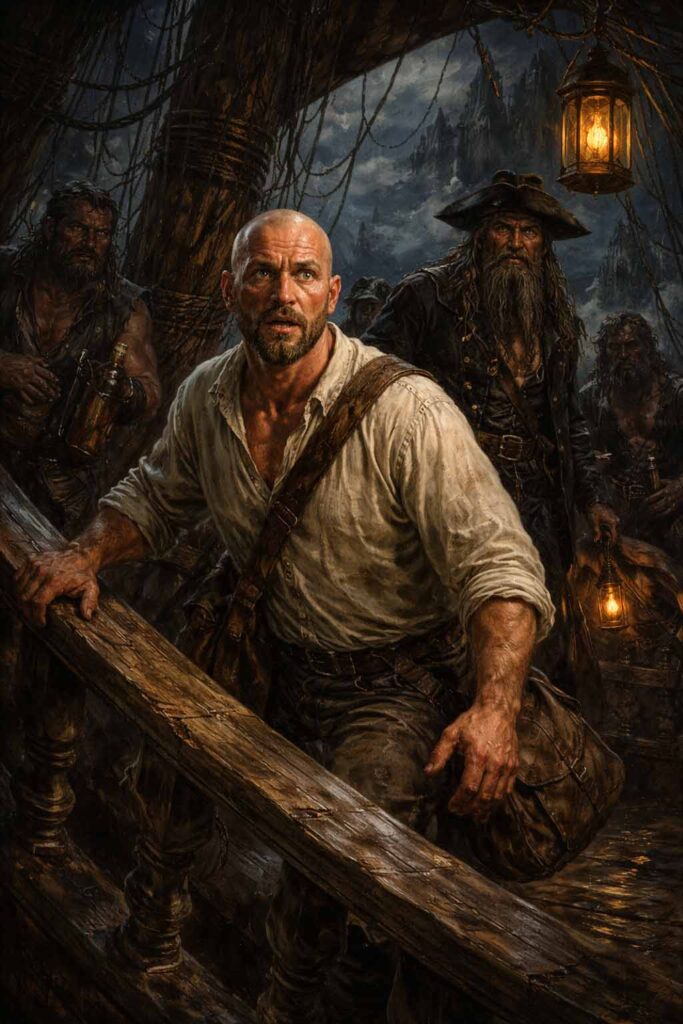
Douglas Brynes the Stowaway and The Pirate Crew
Douglas Brynes had never possessed a mind inclined toward suspicion. This deficiency—if such it may be called—had followed him like a mild fog throughout his life, softening the edges of the world and persuading him, time and again, to accept appearances as truths. Thus it was that, upon a night veiled in salt mist and trembling lantern-light, he mistook a vessel of rotting oak and iron malice for the civilized promise of a cruise ship, and stepped aboard with nothing more than a leather satchel, a ticket clutched in good faith, and the quiet certainty that the sea, at least, was an honest thing.
The harbor slept uneasily. Ropes creaked like arthritic bones, and the water lapped against the pilings with a sound not unlike whispering teeth. Douglas noticed these things dimly, as one notices the ticking of a clock only after it has ceased. He saw the ship’s silhouette—tall-masted, blackened, imposing—and assumed it to be a quaint indulgence of nautical nostalgia, a themed excursion perhaps, designed to charm tourists with theatrical antiquity. He even smiled at the skull nailed beneath the prow, supposing it an emblem of ironic amusement.
No one challenged him as he boarded.
This, too, should have troubled him. Yet Douglas merely nodded to the shadows and descended into the belly of the ship, where the air was thick with pitch, rum, and a deeper scent—metallic, old, and faintly sweet, like dried blood remembered by wood. He found a narrow cabin, windowless, with a hammock swaying gently as if stirred by a breath he could not feel. Fatigue, the great accomplice of error, claimed him quickly.
When he awoke, the ship was screaming.
It was not the cry of timbers alone, though they groaned with the anguish of things long abused. It was the roar of men—raw, jubilant, unrestrained by civility or law. Douglas sat upright, heart pounding, his confusion blossoming into dread as unfamiliar sounds assaulted him: the clash of steel, the barked cadence of commands, laughter edged with cruelty.
He emerged onto the deck and beheld a scene torn from some fevered chronicle of depravity.
The men were not crew as he had known them—uniformed, polite, eager for gratuities—but creatures fashioned by the sea’s darker appetites. Their garments hung in tatters, their skin bore the ink of profane symbols, and their eyes gleamed with the restless hunger of predators. Pistols gleamed at their belts. Cutlasses kissed the light with obscene intimacy. At the helm stood a figure unmistakable in authority: a captain with a beard like a funeral shroud and eyes so pale they seemed already dead.
Douglas spoke before he thought, for silence can sometimes feel like complicity.
“Excuse me,” he said, his voice thin against the wind. “I believe there’s been a mistake.”
The deck grew quiet—not instantly, but gradually, as laughter faltered and eyes turned toward him with dawning curiosity. The captain regarded Douglas as one might regard a curious insect crawling from a coffin.
“A mistake?” the captain echoed, his voice low and rasped by salt and sin. “Aye, there are many such things in the world. But you, sir, are no accident.”
Douglas attempted to explain. He spoke of reservations, of staterooms, of midnight buffets and scheduled entertainment. His words fell into the space between the pirates like pebbles into a well—heard, perhaps, but never returned.
The captain laughed.
It was a sound without mirth, a barked exhalation of contempt. “You’ve boarded the Belladonna, friend. She sails not for pleasure, but for plunder. And no man steps upon her deck without paying a price.”
Douglas felt then the weight of his error, pressing upon his mind until the world seemed to narrow and darken. He was seized, not roughly, but with a practiced efficiency that chilled him more than violence might have. They set him to work immediately—scrubbing decks slick with brine and worse, hauling lines that bit into his palms, descending into holds where stolen treasures lay piled like the hoarded guilt of nations.
Days passed—or nights, for time aboard the Belladonna obeyed no law but the captain’s will. Sleep came in snatches. Food was coarse and sparse. Yet the greatest torment was not physical, but psychological: the unrelenting presence of menace, the knowledge that death aboard the ship was not an event, but an option always under consideration.
Douglas observed the pirates with growing horror. He watched as they descended upon merchant vessels like carrion birds, leaving behind floating wreckage and screams swallowed by the sea. He saw mercy mocked, pleas ignored, and blood washed casually from decks as though it were merely spilled wine.
And still—most disturbingly—he felt himself changing.
At night, lying in his hammock, he listened to the sea gnaw at the hull and felt a strange intimacy with its darkness. The pirates spoke often of the ocean as a living judge, a god that demanded offerings. Douglas, who had once believed the sea honest, began to sense its indifference—to feel that it neither condemned nor absolved, but merely endured.
One evening, as the ship drifted beneath a moon like a blind eye, the captain summoned him.
“You’ve the look of a man haunted,” the captain said, pouring rum into two chipped cups. “Care to confess?”
Douglas hesitated, then spoke of his life before the ship—of modest ambitions, of days governed by habit, of a soul never truly tested. The captain listened with an expression almost tender.
“Then perhaps,” the captain said softly, “this is where you belong.”
The words struck Douglas with the force of a blasphemy. He recoiled—not from the captain, but from the possibility that the man might be right. That the sea, in its merciless wisdom, had stripped away the illusions of safety and revealed the raw truth beneath: that civilization was but a thin veneer, and beneath it lay hunger, fear, and the will to survive at any cost.
That night, the Belladonna was overtaken by a storm of unholy ferocity. Waves rose like living walls. The ship screamed as though aware of its own damnation. Pirates clung to rigging, shouting prayers and curses in equal measure.
Douglas was thrown against the rail, the sea yawning beneath him. In that instant—balanced between annihilation and deliverance—clarity pierced him like lightning. He saw that his greatest terror was not death, but transformation. To live and become like them would be the true perdition.
Summoning a strength born of desperation, Douglas cast himself overboard.
The sea swallowed him whole.
Cold crushed his breath. Darkness pressed against his eyes. He sank, convinced this was the end, and perhaps deserved. But fate—or cruelty—spared him. He awoke upon a stretch of sand, waves retreating from him as if in disappointment.
He never learned how he survived.
When Douglas returned to land, he spoke little of the voyage. He avoided the sea. Yet at night, when the world was quiet and guilt stirred like a tide within his chest, he would dream of black sails against a moonless sky, and wake with the certainty that some part of him still walked the deck of the Belladonna.
For once a man has mistaken damnation for comfort, he is never entirely certain which he escaped.