
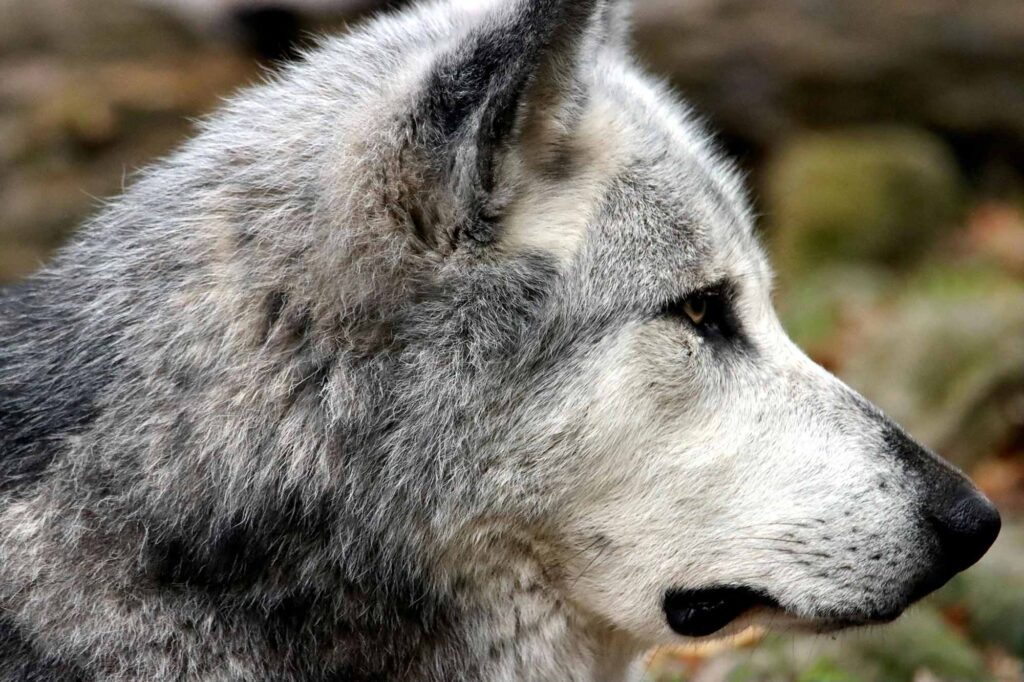
The Fire of the Wolf
The North was a place that did not bargain. It took what it wished and returned nothing but the echo of a man’s own breath. The air there was sharp, and the snow was a living thing, piling itself on the world in sheets and drifts, hiding the tracks of men and animals alike. In such a land, a man could not be half a man. He could not be soft, or careless, or vain. He must be all bone and will, or he would be nothing at all.
Douglas Brynes was not a man of the North.
He was a man of a softer world—streets and shops, warm rooms and friendly voices. He had come to the wilderness for reasons he could not fully explain, but the motive was clear enough: he wished to know himself. He had read the tales of men who had walked into the wild and emerged changed, and he had thought himself brave enough to join them.
The wilderness proved him wrong.
He was not lost at first. He had followed the trail with confidence, his boots crunching in the snow as if he belonged there. The sky was clear, and the air was cold but not yet cruel. He had told himself that he could survive anything.
Then the wind changed.
The sky darkened.
And the trail vanished.
The wilderness had swallowed it, and it had swallowed Douglas too.
He pressed on, driven by stubbornness and a kind of foolish pride. He told himself that the land was simply vast, that he had merely missed a turn. But as the hours passed and the sun dipped toward the horizon, he realized the truth: he was alone, and he was lost.
The cold came quickly then, not like a gradual discomfort but like a sudden strike. Douglas’s fingers began to numb. His breath came out in hard, white bursts. His legs felt like they were made of lead.
He searched for shelter. He searched for anything that could protect him from the night. He found a fallen log and a small depression in the snow, and he crawled into it, curling himself as tightly as he could. He wrapped his arms around his body, trying to conserve heat, trying to hold himself together.
Night fell with a harshness that seemed almost personal.
Douglas lay there, teeth chattering, and he thought of the warm rooms he had left behind. He thought of the stories he had read, and of the men who had claimed the wild as their own. He thought of his own arrogance, and how quickly it had been punished.
Then he heard a sound.
Not a howl, not a growl—just a quiet, cautious step. He opened his eyes and saw, not a man, but a wolf.
The wolf was gray and white, its fur thick and bristling against the cold. Its eyes were bright and watchful. It moved with the careful grace of a creature that belonged to the land, and it stopped a few feet from Douglas’s shelter.
Douglas froze.
He knew the stories. He knew the wolves that hunted in packs. He knew the legends of men torn apart by teeth.
But the wolf did not come closer.
It simply watched.
Douglas held his breath, as if breathing might provoke the creature. The wolf sniffed the air, then shifted slightly, as if deciding whether Douglas was a threat or a curiosity.
The wolf lay down, its body curling in the snow, and Douglas realized with a shock that it was not there to kill him. It was there to share the night.
Douglas felt something in him soften. He was not a man who believed in miracles, but he could not deny what he saw. The wolf was not cruel. It was simply a creature that had recognized another creature in need.
The night passed in a tense, uneasy companionship. Douglas could not sleep. The wolf remained alert, its eyes flicking toward every sound. Douglas watched it, and the wolf watched him, and in the silence between them something unspoken passed.
When dawn came, Douglas realized he was still alive.
He rose slowly, his body aching. He looked at the wolf, and the wolf looked back, as if to say, You have one chance.
Douglas knew what he must do.
He needed fire.
He had no matches. No flint. No lighter. He had only his knife, a small piece of rope, and the clothes on his back. He looked at the trees, at the snow, at the barren world, and he knew the wilderness would not forgive him if he failed.
He gathered dry twigs and branches, scraping beneath the snow to find the dry wood hidden below. His hands were numb, and the cold cut into his skin like a blade. He tried to create friction with his knife and a rock, and he struck again and again, sparks flying and disappearing into the air.
He felt the weight of his own helplessness.
The wolf watched, its eyes steady and unblinking.
Douglas struck his knife again, harder. The spark caught. A thin line of smoke rose. A tiny flame flickered, weak and trembling, like a newborn.
Douglas’s heart surged.
He fed the flame carefully, adding dry leaves, then twigs, then small branches. The flame grew slowly, stubbornly, and soon he had a fire.
The warmth rushed into him like a wave. The cold loosened its grip. Douglas felt the first true sense of relief since he had entered the wilderness.
The wolf lay beside the fire, its fur glowing in the light. It did not move away. It did not flee. It stayed, as if the fire belonged to both of them.
For a moment, Douglas felt a strange kinship with the creature. He realized that the wolf was not merely a wild animal—it was a fellow survivor. It knew the land, the hunger, the cold. It understood the rules of the wild better than Douglas ever would.
That day, Douglas began to walk.
He followed the river, knowing that water often leads to civilization. The wolf followed too, keeping pace without needing to be told. Douglas began to think of the wolf as a companion, not a threat. He began to feel a kind of respect for it, a recognition of its strength.
But the wilderness was not kind.
On the second day, Douglas stumbled and fell into a shallow stream. The cold water soaked his clothing, and his body shuddered violently. He fought to get out, and the wolf—without hesitation—grabbed his sleeve with its teeth and tugged him to the bank.
Douglas pulled himself up, gasping. The wolf shook its fur, sending water droplets into the air.
Douglas looked at the wolf with a new sense of awe. It had saved him.
He realized then that he had been wrong to think of himself as the master of the wild. He was only a guest, and the wild did not care for his pride.
That night, the sky darkened with storm clouds. The wind rose, howling through the trees. The snow began to fall heavily, and the world turned white. Douglas built a shelter of branches and bark, but the wind tore at it, and the snow seeped through.
The wolf, sensing the danger, nudged Douglas and led him to a deeper grove, where the trees were thicker and the snow did not fall as hard. It was a shelter that Douglas would never have found on his own.
Douglas lay down beside the wolf, his body trembling.
The wolf lay close, its warmth pressed against him.
Douglas realized then that the wolf was not only a companion. It was a teacher.
And the lesson was simple:
In the wild, no one survives alone.
On the third day, Douglas finally saw the signs of civilization. He saw a faint trail, half-hidden beneath the snow. He saw the broken branches of a path, the marks of men who had passed before him. His heart lifted with hope.
He followed the trail, and the wolf followed too, its eyes bright with quiet satisfaction.
But the trail led to something unexpected.
It led to a cabin.
A small, weather-beaten cabin, half-buried in snow, with smoke rising from its chimney. Douglas’s heart leapt. Civilization! Warmth! Food! Safety!
He approached cautiously, not wanting to frighten anyone inside. He knocked on the door, and after a moment it opened.
An old man stood there, his face weathered and lined, his eyes sharp and wary. He stared at Douglas, then at the wolf, and his expression shifted from suspicion to recognition.
“A wolf,” he said softly. “You brought him with you.”
Douglas nodded. “He saved me.”
The old man studied the wolf. “Wolves are not friendly,” he said. “But sometimes they are not enemies either.”
Douglas looked at the old man, and he felt the weight of the wilderness in the man’s gaze. He understood then that the old man had lived in this land long enough to know its rules.
The old man opened the door wider. “Come in,” he said. “You’ll freeze out here.”
Douglas stepped inside, and warmth rushed over him like a wave. He could smell stew and wood smoke. He could see a fire burning in the hearth. He could feel the comfort of human life.
The old man watched him carefully as Douglas warmed his hands by the fire. “You were lucky,” he said. “The wilderness doesn’t often give second chances.”
Douglas nodded, his eyes shining with gratitude. “I was foolish,” he admitted. “I thought I could conquer it.”
The old man chuckled softly. “Conquering is for fools. The wild does not care for your pride.”
Douglas looked at the wolf, who lay by the fire, its eyes half-closed but alert. He realized then that the wolf was not a creature to be feared, but a creature to be respected.
He thought of the lessons he had learned—of fire and hunger, of cold and companionship, of the quiet strength of the wild.
He realized that he had come into the wilderness seeking himself, and he had found something far greater:
a humility that made him stronger.
When Douglas left the cabin the next morning, the wolf followed him to the edge of the woods. Douglas knelt and touched the wolf’s fur gently. The wolf leaned into his hand, and for a moment Douglas felt a bond that went beyond words.
“You saved me,” Douglas whispered.
The wolf looked at him with steady eyes, then turned and disappeared into the trees, leaving Douglas to return to the world of men.
Douglas Brynes returned to civilization changed. He carried the memory of the wolf and the fire with him like a secret. He understood, now, that the wilderness was not a place to conquer but a place to respect.
And he knew, deep in his bones, that the wild would always be waiting—silent, watchful, and unyielding—ready to test any man who dared to enter.