
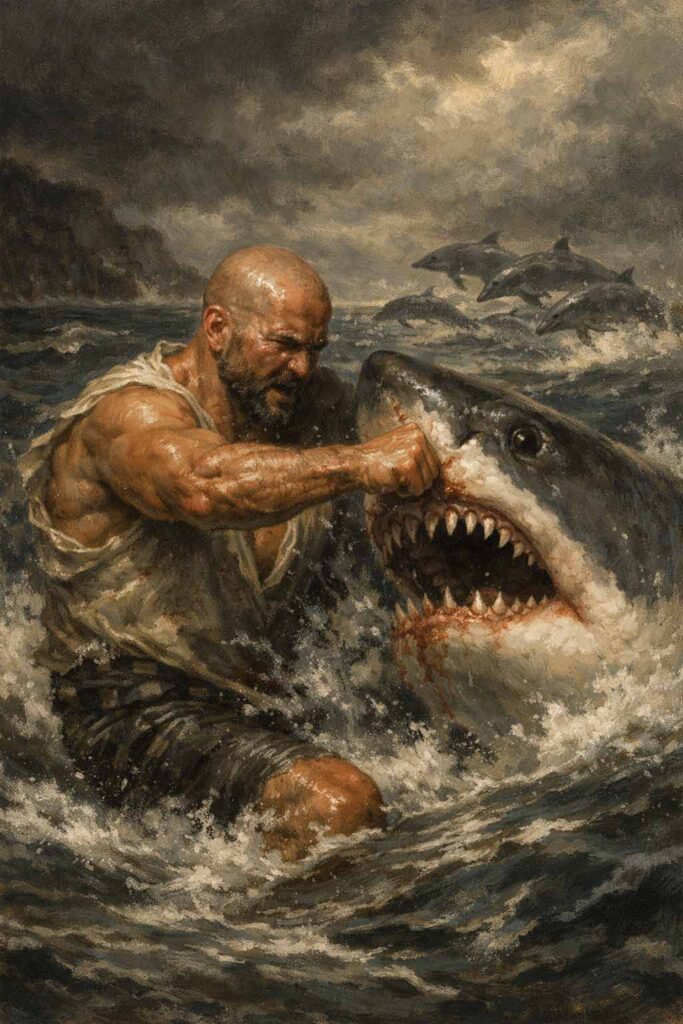
Douglas Brynes Fights Great White Shark
Douglas Brynes had not set out that morning with the intention of testing the moral architecture of the universe, yet such trials seldom announce themselves beforehand. He had come to the sea as a man comes to a mirror he does not fully trust—seeking reflection, perhaps absolution, and certainly a measure of solitude. The coast lay gray and contemplative beneath a veil of mist, the waves rolling in with a solemn persistence that suggested not violence, but judgment patiently deferred.
Douglas stood at the edge of the shore, his boots damp with brine, his coat heavy with the salt-laden air. He was a man past the recklessness of youth but not yet reconciled to stillness. His life, though outwardly unremarkable, had been shaped by a long and quiet reckoning with conscience. He believed—though he rarely said so aloud—that the world was not governed merely by chance, but by a subtle moral current, one that drew men toward moments in which their true natures were revealed.
That morning, the sea seemed unusually hushed, as though withholding a secret.
He waded into the water, cold biting immediately through leather and wool, and swam beyond the breakers with deliberate strokes. Douglas was no stranger to the ocean; he respected it too deeply to presume mastery. The water darkened beneath him, the surface above closing like a lid upon a forgotten book. As he floated, he felt the peculiar sensation of being suspended between two immensities—the sky above, inscrutable and pale, and the depths below, ancient and unillumined.
It was then he saw them.
A school of dolphins moved through the water with an unthinking grace, their bodies silvered by refracted light, their motions guided not by fear but by an innocent communion with the sea itself. They passed near Douglas, scarcely acknowledging him, their clicks and whistles echoing faintly like half-remembered prayers. There was joy in their movement, but it was the joy of creatures unburdened by foresight.
Douglas felt a stirring in his chest, a warmth tinged with unease. Innocence, he knew, was a fragile thing—not because it was weak, but because it did not know how to defend itself.
The water shifted.
At first, it was only a pressure, a subtle displacement that registered not in sight but in instinct. The dolphins sensed it too, though dimly, their formation tightening without panic. Douglas’s breath caught as a shadow passed beneath them, vast and deliberate, moving with the confidence of something that had never questioned its right to exist.
The great white shark emerged from the deep like a thought long suppressed.
Its body was immense, pale beneath and dark above, a living division between light and abyss. Scars marred its hide, each a testament to survival earned through violence and endurance. Its black eyes were devoid of malice, yet equally devoid of mercy. It did not hate the dolphins; it did not even desire them in any emotional sense. It obeyed a law older than conscience, a command written into flesh and hunger.
Douglas understood, in that instant, that he was witnessing not evil, but inevitability.
And yet—inevitability, he believed, was not the same as necessity.
The dolphins swam on, blissfully unaware, their innocence rendered tragic by contrast. The shark angled upward, its movements precise, unhurried. Douglas felt fear bloom within him, sharp and undeniable. His body recoiled even as his mind advanced toward a conclusion he had not consciously chosen.
If he did nothing, the sea would proceed as it always had.
If he intervened, he would be opposing not merely a creature, but the ordained order of things.
Douglas thought of all the moments in a man’s life when he excuses himself by invoking nature, custom, or fate. He thought of how often cruelty survives because it wears the mask of inevitability. And he thought, with sudden clarity, that conscience was meaningless unless it was willing to place itself in peril.
He kicked hard, propelling himself between the shark and the dolphins.
The water churned violently as Douglas struck the surface, shouting—a futile sound swallowed instantly by the sea. He waved his arms, making himself large, absurd, and fragile. The shark veered slightly, startled perhaps by this intrusion of will where none was expected.
The dolphins scattered, confusion rippling through their ranks.
The shark turned its full attention upon Douglas.
He felt its presence like a weight upon his soul. The great head moved closer, jaws parting just enough to reveal rows of teeth—ivory instruments of a purpose that required no justification. Douglas’s heart thundered in his ears. Every instinct urged him to flee, yet his limbs remained where they were, trembling but resolute.
In that suspended moment, Douglas confronted the terrible symmetry between man and beast. The shark killed to live. Man, too, had killed in the name of survival, prosperity, progress. The difference lay not in the act, but in the capacity to choose otherwise.
The shark lunged.
Douglas reacted without thought, driving his arm downward with all the force he could muster, striking the sensitive snout. Pain exploded through his hand, white and blinding, but the shark recoiled, thrashing the water into chaos. Blood bloomed—not from the shark, but from Douglas’s torn skin, a thin crimson cloud diffusing rapidly into the sea.
The scent changed everything.
The shark circled, agitated now, its movements sharper, less contemplative. Douglas’s strength waned as the cold tightened its grip. He struck again, and again, not with hope of victory, but with the stubborn insistence that moral resistance, however futile, must be enacted to be real.
At last, something shifted.
Whether it was confusion, injury, or the intrusion of too many variables into a simple calculus of hunger, the shark turned away. It descended slowly into the depths, its great form dissolving into darkness as though absorbed back into the conscience of the sea.
The dolphins were gone.
Douglas remained afloat, barely.
He drifted, gasping, pain radiating through his body, his mind wavering between consciousness and surrender. The sea, having tested him, now bore him gently toward shore, waves lifting and releasing him with a strange tenderness. When he awoke fully, he lay upon wet sand, the sky above him pale and indifferent, the mist thinning as if nothing extraordinary had occurred.
Days passed before Douglas fully recovered. His wounds healed into scars—quiet, unremarkable marks that invited no admiration. He spoke little of what had transpired, and when he did, his words lacked triumph. He did not consider himself a hero. Heroism, he believed, implied a certainty of righteousness he did not possess.
He had not defeated the shark.
He had only delayed hunger.
Yet in the quiet hours, when Douglas walked again by the sea, he felt a deeper alteration within himself. He had learned that morality was not a grand doctrine but a series of solitary decisions, made often in fear and always without assurance of success. He had learned that innocence, once recognized, imposes an obligation that cannot be unlearned.
Some evenings, he thought he glimpsed dolphins far offshore, their bodies breaking the surface in brief arcs of light. Whether they were the same, he could not know. Perhaps it did not matter.
What mattered was that, for one fleeting interval, a man had placed his fragile will against the vast machinery of nature—not to conquer it, but to remind it, and himself, that conscience, too, was a force, however small, that moved through the world.