
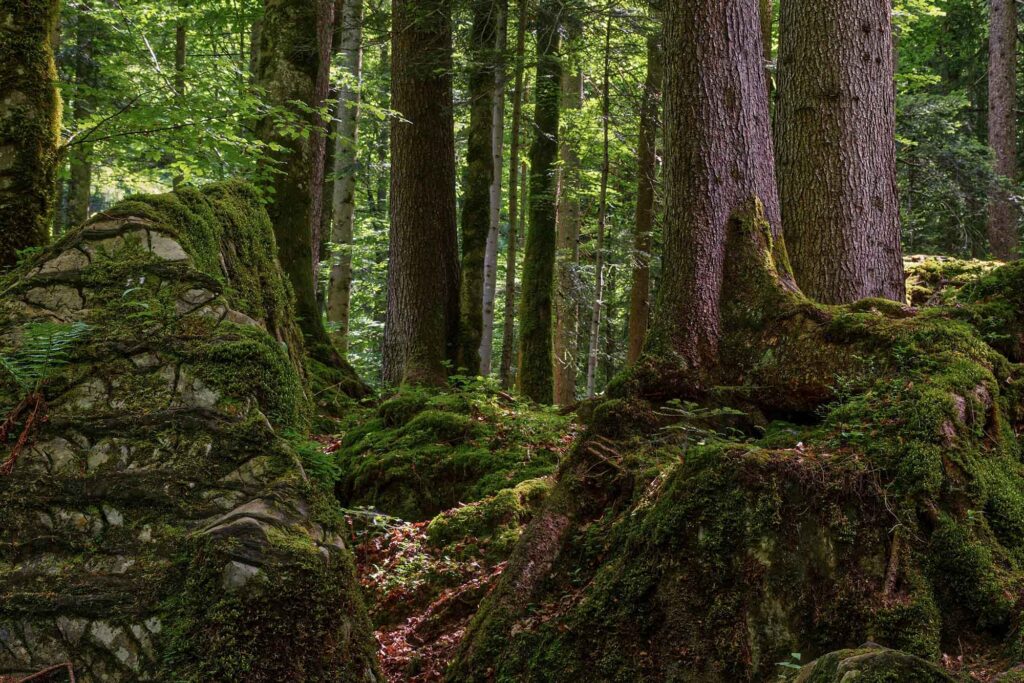
Douglas Brynes went into the Adirondacks the way other men went into conversations they did not intend to dominate. He carried only what was necessary, and even that he carried lightly, as if the forest might take offense at excess. His boots were scuffed from earlier seasons, his pack smelled faintly of smoke and pine pitch, and his hands bore the quiet scars of someone who preferred making things to buying them.
He chose his campsite with care, not for the view but for the feeling. The lake lay still as a held breath, ringed by spruce and birch that had learned long ago how to endure winters without complaint. A low ridge rose behind the site, sheltering it from wind. Douglas set his tent with practiced movements, hammered his stakes, and stood for a moment afterward, listening. Somewhere far off, a loon called. The sound echoed and returned altered, as though the forest were thinking about it before answering.
By the time evening settled in, Douglas had a small fire going. Not a roaring one—he distrusted spectacle—but a steady flame that warmed without demanding attention. From his pack he removed a block of cherry wood, roughly cut, heavy with promise. He ran his thumb across the grain and smiled faintly. Cherry was a patient wood. It forgave mistakes if you were honest with it.
He was whittling a bass guitar.
The idea had come to him months earlier while listening to a low, resonant note drift from a radio left on in a workshop. Bass notes, he thought, were like truths that didn’t interrupt. They didn’t shout for agreement; they simply existed beneath everything else, holding things together. He wanted to make an instrument that sounded like the forest felt—deep, steady, unbothered by the passage of trends.
The first night passed quietly. Douglas slept with the ease of someone who trusted the dark. He woke before dawn, brewed coffee over the coals, and watched mist lift off the lake like a slow confession. He worked on the bass throughout the day, pausing only to eat or stretch his hands. Chips of cherry wood gathered at his feet, their scent sweet and grounding.
On the second day, he noticed tracks.
They were not obvious. That was the thing. If Douglas had been the sort of man looking for mysteries, he might have missed them entirely. The impressions were large, yes, but softened by needles and time. Not bear. Not moose. Too deliberate. Too human in shape, though stretched beyond what any man he knew could manage.
Douglas studied them, then shrugged.
The forest, he believed, owed no explanations.
By the third evening, clouds gathered low and thick, bruised purple and gray. The air grew heavy, charged with the promise of rain. Douglas sat by the fire again, bass guitar taking shape in his lap. The body was emerging now, its curves smooth beneath his hands. He had begun to imagine the instrument finished—strings taut, wood humming, vibrations traveling through chest and bone.
That was when the forest inhaled.
At first, Douglas thought it was thunder rolling early, but the sound had weight, a deliberate shifting. Branches bent. Leaves whispered urgently to one another. The birds went silent all at once, as if a conductor had dropped his hand.
Douglas looked up.
Across the clearing, just beyond the reach of firelight, something stood where nothing had been before.
It was tall—far taller than any man—and broad in a way that suggested strength without clumsiness. Its body was covered in dark hair, matted in places, catching twigs and the faint glow of embers. Long arms hung at its sides, hands relaxed but capable. Its posture was neither aggressive nor timid. It stood as if it belonged there, which, Douglas realized, it did.
Bigfoot.
The word flickered through Douglas’s mind, then drifted away like smoke. Names were tools, and this moment did not require one.
The creature stepped forward, and the firelight revealed its face. The features were unmistakably human-like—eyes set deep, brow heavy, mouth neutral. There was intelligence there, and something else too: caution worn smooth by centuries of observation.
Douglas felt no fear.
Fear, he had learned, was often a misunderstanding that refused to slow down.
He rested his knife against the cherry wood and met the creature’s gaze. They regarded one another in silence, two beings interrupted mid-task by chance rather than destiny.
Douglas gave a small, nonchalant nod.
It was the same nod he might give a neighbor passing on a trail, or a stranger sharing a moment of weather. Not a challenge. Not submission. Just recognition.
The creature blinked once. Its chest rose and fell, slow and deep. Then, almost imperceptibly, it nodded back.
In that gesture lived an entire understanding: We see each other. No harm is intended. Carry on.
The forest exhaled.
The giant turned and stepped away, melting into shadow and trees as though it had never been separate from them. Branches settled. Leaves resumed their quiet conversations. Somewhere, a bird tested its voice again.
Douglas waited a moment longer, then returned to his work.
The knife moved with renewed steadiness. He refined the curve of the bass’s body, smoothing imperfections, listening to the subtle feedback of wood beneath steel. Rain began to fall, light at first, tapping gently on leaves and canvas. The fire hissed softly but held.
As darkness deepened, Douglas leaned the unfinished instrument against a log and stretched his hands. His fingers ached pleasantly, the way they did after honest labor. He ate a simple meal, cleaned his knife, and crawled into his tent.
Sleep came easily.
Over the next days, Douglas remained. The rain passed. Sun returned, filtered green and gold through the canopy. He continued shaping the bass guitar, carving the neck, fitting the headstock, imagining the tension of strings yet to be strung. Sometimes he thought he sensed movement beyond the trees, a presence watching without urgency. Other times, there was nothing but wind and squirrels and the creak of trees adjusting themselves.
On the final night, Douglas finished the body.
He ran his hands over the cherry wood, now smooth and alive, its grain catching light like slow-moving water. He tapped it lightly with his knuckle and smiled at the deep, promising tone. It wasn’t finished—not truly—but it was enough.
He sat by the fire, holding the bass, and hummed a low note to himself. The sound blended with the night, with crickets and distant owls, with the quiet breathing of the forest itself.
When Douglas broke camp the next morning, he left little behind. The fire pit was cold and clean. The ground bore only faint impressions that would soon soften and vanish. He slung the wrapped bass over his shoulder and took one last look at the lake.
For a moment, he thought he saw a tall shape among the trees on the ridge. Maybe it was shadow. Maybe it was memory already forming.
Douglas nodded once more, just in case.
Back home, when friends asked about his trip, Douglas said it was quiet. He said the air was good. He said the wood was excellent. When they noticed the bass guitar and asked where he’d learned to carve like that, he shrugged and said, “You listen long enough, things teach you.”
He never spoke of the giant.
Some things, he believed, did not belong to stories meant for proving. Some moments were not encounters but agreements—silent, mutual, and best left unmeasured.
And sometimes, late at night, when Douglas played the bass and let the low notes roll through the room like distant thunder, he thought of the Adirondacks breathing in the dark, and of a tall, watchful presence nodding back, satisfied that the world was still, for the moment, in capable hands.